
How to Read a Supplement Label
Understand serving sizes, ingredient amounts, units, reference values and common claims on UK and US supplement labels.

In brief
- Compare the amount per recommended daily portion, not the largest number on the pack.
- Check every product you take to avoid unintentionally doubling up.
- Treat disease claims or missing supplier information as warning signs.
Supplement packaging is designed to sell, not necessarily to inform. Bold claims on the front of the box, like "supports immunity" or "high strength", tell you very little about what's actually inside or whether it's right for you. The real information is on the back, in the small print, and knowing how to read it properly is one of the most useful skills for anyone who takes supplements regularly. This guide walks through what to look for.
Start with the ingredients list and the nutrition panel
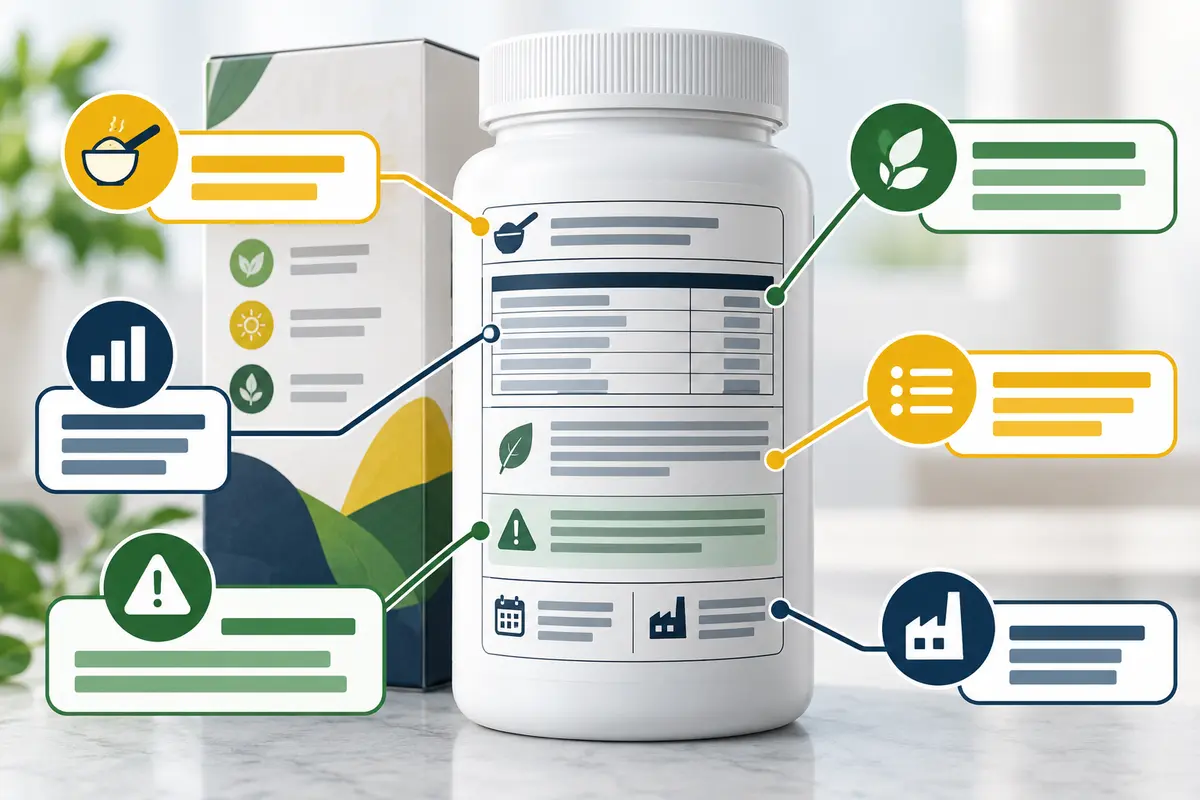
UK food-supplement labels must include the product name, a list of ingredients, the recommended daily portion, the amount of relevant vitamins or minerals in that portion, and the percentage of the applicable reference value. They must also carry required warnings, including not exceeding the stated dose and keeping the product out of young children's reach.
Check the serving size carefully. Some products list nutrient amounts "per capsule" and separately recommend taking two or three capsules a day, so the meaningful figure is the total for the full recommended daily serving, not the per-capsule number that might catch your eye first.
Understanding %NRV
Most UK and EU supplement labels show a percentage figure next to each nutrient, labelled %NRV, which stands for Nutrient Reference Value. This is a standardised reference amount, broadly similar in concept to the old "Recommended Daily Allowance", used to help you judge how a product's dose compares to a general daily target for the average adult.
A product offering 100% NRV of vitamin C is providing roughly a full day's general reference amount in one serving. A product offering 500% NRV is providing five times that amount. High percentages aren't automatically dangerous, some nutrients have wide margins of safety, but it's worth knowing what you're taking, especially if you're also getting the same nutrient from other supplements or fortified food. The NRV also doesn't account for what you're already getting from your normal diet, so it's a reference point for the supplement alone, not a measure of your total daily intake.
The form of the ingredient matters, not just the amount
Two supplements can list the same nutrient and the same headline dose, yet behave quite differently in the body, because of the chemical form used. This is a detail that's easy to miss but genuinely matters:
- Iron supplements come in several forms. The amount of elemental iron, dose and formulation can affect suitability and side effects, but there is no single best form for everyone. Use the amount stated on the label and follow advice from a pharmacist or prescriber.
- Magnesium is sold in several forms. Absorption and tolerance can differ, but marketing often exaggerates those differences. Compare the stated amount of magnesium per daily portion and avoid assuming that a fashionable form is automatically better.
- For vitamins and minerals, the label should state the amount of the nutrient supplied by the recommended daily portion. Check the calcium amount itself rather than relying on the compound name or a large number on the front of the pack.
If the nutrient amount or recommended daily portion is unclear, choose a product with clearer labelling or ask a pharmacist before buying it.
Other-ingredients: fillers, additives and allergens
Below the active nutrients, most labels list "other ingredients", which typically include bulking agents, anti-caking agents, capsule shell material (often gelatine, or a vegetarian/vegan alternative such as HPMC), and sometimes flavourings or colourings. These are generally present in small amounts and aren't usually a cause for concern, but they're worth checking if you have specific sensitivities or dietary requirements.
UK labels must emphasise any of the 14 regulated allergens used as ingredients. Read the full ingredients and allergen statement, and contact the manufacturer if your allergy is severe and the source of an ingredient is unclear.
What UK law does and doesn't allow suppliers to claim
In the UK, food supplements are regulated as food, not medicine, which has an important consequence for the claims allowed on the label. Suppliers are legally permitted to make specific, pre-approved claims about how a nutrient contributes to normal bodily function (for example, "vitamin C contributes to normal immune function" is an approved claim), but they are not permitted to claim that a product can prevent, treat or cure a disease. Language implying medicinal effects, without the product being licensed as a medicine by the MHRA, is against UK advertising and food law.
Health claims used for food supplements in Great Britain must be authorised and used under the relevant conditions. Treat wording that promises to treat, prevent or cure a disease as a warning sign: products making medicinal claims may fall under medicines law.
Practical red flags to look out for
A few things are worth treating as a prompt to look more closely, or choose a different product:
- Proprietary or "complex" blends that list a group of ingredients with only a combined total weight, rather than the individual amount of each one, making it impossible to know how much of any single ingredient you're actually getting.
- No manufacturer or importer name and address on the label. UK and EU food law requires this, and its absence is a sign the product may not meet standard regulatory requirements.
- Doses far above the NRV with no clear explanation of why, particularly for nutrients with known safety limits, such as vitamin A, vitamin D, iron or zinc.
- Claims to treat, cure or prevent a specific medical condition.
- Missing date or traceability information. Prepacked foods normally require a best-before or use-by date and a lot mark, although in some cases a date can also serve as the lot identification.
A quick checklist for comparing two products
When comparing similar supplements side by side, it's worth checking: the actual dose of each active ingredient (not just the headline nutrient on the front of the pack), the %NRV where relevant, the form of any minerals present, the full ingredients list for fillers and allergens, the serving size and how many servings you'd need to reach that dose, and whether the manufacturer's details are clearly listed.
A note for readers outside the UK
Labelling rules differ by country. In the United States, dietary supplements are regulated by the FDA under a different framework (the Dietary Supplement Health and Education Act), and labels use a "Supplement Facts" panel showing amounts and %Daily Value rather than the UK/EU-style %NRV. The figures themselves may also differ, since Daily Values and Nutrient Reference Values aren't always set at the same level for the same nutrient. If you're buying supplements in, or importing them from, the US or another country, it's worth checking that country's equivalent labelling standard rather than assuming the numbers translate directly.
The bottom line
The front of a supplement pack is marketing; the nutrition panel and ingredients list on the back are the facts. Taking a few extra seconds to check the actual dose, the form of each ingredient, and the small print, rather than the headline claim, is the single most useful habit for choosing supplements sensibly.
Sources and further reading
Guidance can change. These official sources were checked when this article was reviewed.